
OVERALL ASSESSMENT
FOUR MODES OF MIND AND THE GATES OF STABILITY is:
- deep,
- serious,
- systematic,
- and profoundly honest about lived experience.
⭐ Best suited for:
- those who have tried many methods,
- those who understand much but feel misaligned,
- those willing to observe rather than fix themselves.
⚠️ Not suitable if:
- you seek quick techniques,
- need emotional reassurance,
- or expect a clearly defined spiritual path.
If summarized in one sentence:
This is not a book that makes you more peaceful—
it helps you stop doing the things that prevent peace from returning.
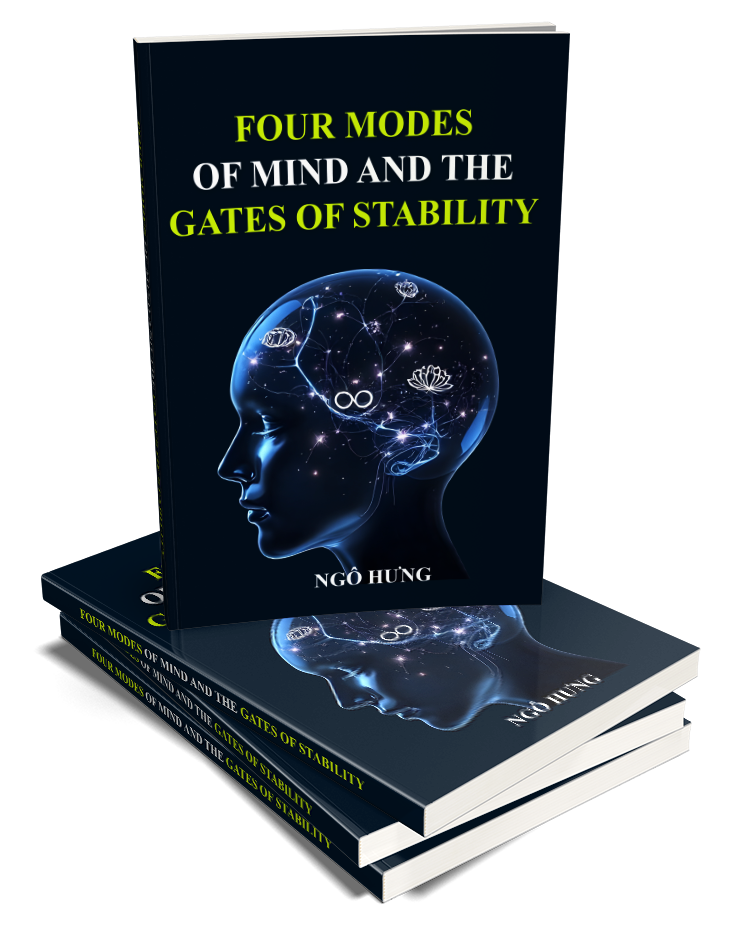
COMPREHENSIVE AND PROFESSIONAL REVIEW
Based on the complete manuscript “FOUR MODES OF MIND AND THE GATES OF STABILITY” that you provided, below is a comprehensive evaluation in an academic–experiential–critical spirit, faithful to the book’s internal logic.
OVERVIEW & POSITIONING OF THE WORK
FOUR MODES OF MIND AND THE GATES OF STABILITY is not:
- a classical Buddhist text,
- a self-help book,
- nor a psychological therapy manual.
The book occupies a distinct position:
👉 a map describing how the body–mind–modes-of-mind system operates when stability and instability arise.
Most importantly:
- The book does not teach what to do
- It does not promise healing
- It does not ask for belief
- It does not offer methods
Instead, it continually returns to a single axis:
Correct understanding, so as not to intervene incorrectly
In terms of positioning, this is a deconstructive work, not an instructional system.
KEY STRENGTHS
- A clear and rare conceptual framework
The opening glossary is one of the book’s strongest features.
Concepts such as:
- Body-Mind Mode
- Subconscious Mode
- Ego-Mind Mode
- Consciousness – Intellect – Wisdom Faculty
are:
- clearly defined,
- used consistently,
- and not arbitrarily mixed with Buddhist, psychological, or meditative terminology.
👉 This avoids a very common pitfall in “awakening” literature:
using the same word for multiple operational levels.
- A “non-moral, non-healing” approach
A major contribution of the book is its removal of morality from suffering and peace.
Suffering is not:
- caused by wrongdoing,
- weakness,
- or insufficient practice.
Suffering is simply:
a prolonged state of instability due to conflicts not resolved at the correct level.
This perspective:
- reduces self-blame,
- reduces the compulsion to “be better,”
- reduces self-forcing to “let go, understand, accept.”
- Clarifying the central role of Ego-Mind Mode
Separating Ego-Mind Mode from:
- ego,
- moral self,
- negative self-image
is highly valuable.
In the book, Ego-Mind Mode:
- is not the source of suffering,
- but the center that senses stability/instability,
- and where the need to restore stability arises.
👉 This helps readers:
- stop fighting the “self,”
- stop trying to eliminate emotions,
- stop treating instability as an enemy.
- The logical sequence: body → data → emotion → consciousness
The operational order:
Body-Mind Mode → Subconscious Mode → Ego-Mind Mode → Consciousness
is experientially convincing, especially for:
- meditators,
- therapy clients,
- those who “understand a lot yet still suffer.”
The book precisely explains:
- why thinking fails to resolve emotions,
- why correct understanding does not guarantee peace,
- why excessive healing efforts create more confusion.
LIMITATIONS & POINTS OF CAUTION
- Difficult for general readers
The writing style is:
- slow,
- intentionally repetitive,
- abstract,
- sparse in everyday examples.
This:
- suits readers with inner experience,
- but challenges beginners or those in acute distress.
👉 Risk:
- readers may “understand intellectually” without embodied verification.
- Not suitable for those seeking quick solutions
The book:
- offers no exercises,
- no checklists,
- no “five-step process.”
For readers with:
- severe anxiety,
- depression,
- panic disorders,
reading without parallel support may lead to:
- disappointment,
- or misunderstanding “non-intervention” as passivity.
- High neutrality may feel “cold”
By removing:
- comforting language,
- guiding tone,
- encouragement,
the book becomes:
- cognitively clean,
- but may feel “dry” or distant.
This is not a flaw, but a stylistic choice—one that readers need to recognize correctly.
BRIEF COMPARISON WITH FAMILIAR GENRES
|
Compared with |
Key Difference |
|
Thích Nhất Hạnh |
Less poetic, less meditative flavor, mindfulness not used as a method |
|
The Power of Now |
No emphasis on the present, no opposition to thinking |
|
Healing books |
No promise of healing, no trauma-seeking |
|
Buddhist texts |
No sermons, no doctrine, no liberation goal |
👉 This book is closer to an operational map than a spiritual path.
OVERALL ASSESSMENT
FOUR MODES OF MIND AND THE GATES OF STABILITY is:
- deep,
- serious,
- systematic,
- and profoundly honest about lived experience.
⭐ Best suited for:
- those who have tried many methods,
- those who understand much but feel misaligned,
- those willing to observe rather than fix themselves.
⚠️ Not suitable if:
- you seek quick techniques,
- need emotional reassurance,
- or expect a clearly defined spiritual path.
If summarized in one sentence:
This is not a book that makes you more peaceful—
it helps you stop doing the things that prevent peace from returning.
MULTI-PERSPECTIVE EVALUATION:
Buddhism – Psychotherapy – Neuroscience
BUDDHIST PERSPECTIVE
- Compatibility with Early Buddhism
✅ Deeply aligned in spirit, not in terminology.
The book:
- does not use the Four Noble Truths,
- does not present the Eightfold Path,
- does not explicitly teach impermanence, non-self, or suffering,
yet closely touches the operational core of early Buddhism:
- suffering is not moral,
- suffering arises from misunderstanding process,
- cessation comes not from “doing more” but from ceasing incorrect intervention.
Central proposition:
Stability is the baseline state, naturally present when conflicts are resolved at the correct level.
→ Spiritually equivalent to:
Nirvana is the cessation of greed, hatred, and delusion—not a state to be attained.
- Comparison with the Four Noble Truths
|
Four Noble Truths |
Four Modes (Book) |
|
Dukkha |
Prolonged instability |
|
Samudaya |
Wrong-level intervention / unclosed data |
|
Nirodha |
Completion of process |
|
Magga |
Correct operational order, not a path |
📌 Key difference:
- Buddhism proposes a path of practice
- This book refuses paths and only describes the system
→ A rare non-soteriological approach in Buddhist-adjacent literature.
- Buddhist strengths
- No moralization of suffering
- No misinterpretation of non-self as self-destruction
- No sanctification of awakening
- No framing emotions as obstacles
👉 Close to:
- Kalama Sutta (do not believe merely because it is said)
- Ehipassiko (“come and see”)
- Gentle Buddhist critique
⚠️ Traditional Buddhist readers may feel uneasy with:
- the concept of Ego-Mind Mode,
- lack of explicit impermanence, dependent origination, non-self.
However:
- this is a deliberate choice to avoid abstract doctrine.
👉 The book does not contradict Buddhism, but it does not belong to orthodox Buddhist exegesis.
PSYCHOTHERAPEUTIC PERSPECTIVE
- High compatibility with modern therapies
The book aligns closely with:
- Somatic Therapy
- Trauma-informed Therapy
- Internal Family Systems (IFS)
- Polyvagal Theory (Stephen Porges)
Clear parallels:
- body precedes cognition,
- emotions are signals, not problems,
- therapy is completion, not fixing.
Conceptual mappings:
- Body-Mind Mode ≈ autonomic nervous system
- Ego-Mind Mode ≈ safety regulation center
- Subconscious Mode ≈ implicit memory storage
- Therapeutic strengths
✅ Non-retraumatizing
- no memory excavation,
- no forced recall,
- no emotional catharsis.
→ aligns with nervous-system-safe therapy.
✅ Avoids the “I must heal” trap
Many suffer from:
- “I’m not healed enough,”
- “I’m not doing the method right.”
The book dismantles this by asserting:
There is nothing wrong that needs fixing.
- Therapeutic limitations
⚠️ Not suitable as a primary intervention for:
- severe depression,
- acute anxiety disorders,
- unstable PTSD.
Because it:
- lacks support scaffolding,
- lacks guided safety practices,
- requires high self-observation capacity.
👉 Best used:
- after therapy,
- or alongside guided therapeutic work.
NEUROSCIENCE PERSPECTIVE
- Scientific compatibility
Though non-technical, the structure aligns with modern neuroscience:
|
Book |
Neuroscience |
|
Body-Mind Mode |
Autonomic nervous system |
|
Biological imprint |
Somatic memory |
|
Subconscious Mode |
Implicit memory / pattern storage |
|
Ego-Mind Mode |
Integration hub (insula, limbic system) |
|
Intellect set |
Fast prefrontal processing |
|
Wisdom set |
Slow integrative processing |
Notably:
- distinction between short-term and long-term stability,
- distorted data processing under high emotional arousal,
→ fully consistent with research on stress, trauma, and memory reconsolidation.
- Scientific strengths
- Avoids neuro-reductionism
- Does not absolutize the brain
- Maintains body–mind integration
👉 This is systems-oriented neuroscience, not laboratory reductionism.
- Scientific critique
⚠️ Limitations:
- no empirical citations,
- no clear separation between biological mechanism and phenomenological description.
However:
- the book does not claim to be scientific,
- nor does it make claims beyond available data.
👉 Thus, not incorrect—simply intentionally outside academic neuroscience.
SYNTHESIZED CONCLUSION
At its core, FOUR MODES OF MIND AND THE GATES OF STABILITY is:
- an implicit interdisciplinary work,
- bridging Buddhism, therapy, and neuroscience,
- while fully belonging to none.
Its greatest value:
restoring the natural operational order of being human,
instead of creating more paths, methods, or ideals.
Its sole risk:
- being read intellectually rather than verified somatically.