
OVERALL PROFESSIONAL EVALUATION
- Depth: ⭐⭐⭐⭐⭐
- Practicality: ⭐⭐⭐⭐☆
- Intellectual independence: ⭐⭐⭐⭐⭐
- Reader selectivity: ⭐⭐⭐⭐☆
MOST SUITABLE AUDIENCE
Highly suitable for:
- those who have learned much yet still suffer,
- those who have meditated, understood, yet repeatedly lose peace,
- those exhausted by “having to be positive,”
- those seeking direct verification rather than new beliefs.
Less suitable for:
- complete beginners with no inner observation experience,
- those seeking motivation, inspiration, or a new belief system.
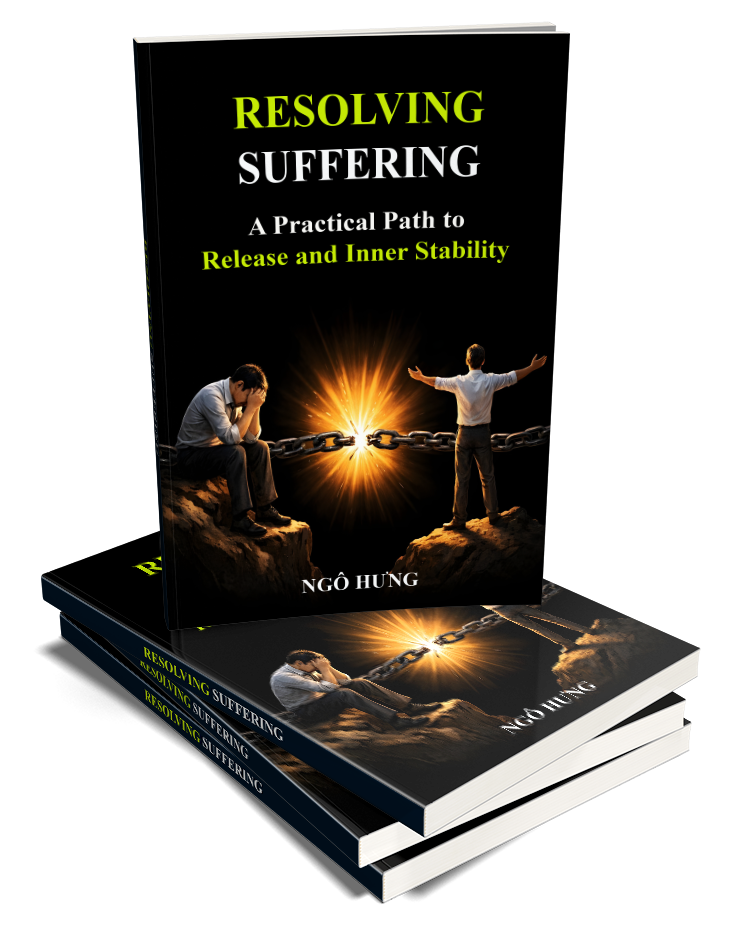
COMPREHENSIVE AND PROFESSIONAL REVIEW
Below is an overall and professional evaluation of the book Resolving Suffering – A Practical Path to Release and Inner Stability by Ngô Hưng, based on the full structure, tone, and content presented in the manuscript Resolving Suffering.
POSITIONING OF THE BOOK
This is not:
- a classical Buddhist doctrinal text,
- a motivational self-help book,
- nor a clinical psychological therapy manual.
The book occupies a very distinctive intersection between:
- direct observation (experiential inquiry),
- the functional structure of mind–body–consciousness,
- and the empirical spirit of early Buddhism,
while deliberately avoiding religious language.
Key point:
👉 The book does not teach “how to get rid of suffering”, but rather “how suffering operates—so that it naturally loses its reason to exist.”
MAJOR STRENGTHS
- A precise and contemporary approach to suffering
Defining suffering as prolonged loss of peace caused by conflict is a major strength:
- it avoids moralizing suffering,
- avoids fatalistic views of suffering,
- avoids idealizing “endurance” or “noble suffering.”
Suffering is restored to its proper place: a functional signal, not a human essence.
👉 This clearly surpasses many books that emphasize “accepting suffering” or “embracing emotions” without explaining the mechanism by which suffering actually ends.
- The PHA (Process-Based) model is coherent and grounded
Dividing the process into PHA stages—from recognition → tracing causes → applying the correct role at each level → action—helps readers:
- avoid getting lost in theory,
- avoid spiritual bypassing,
- avoid misusing tools (e.g., using consciousness to suppress emotion, or meditation to escape real issues).
The redefinition of roles is especially clear and consistent:
- subconscious = associative storage,
- emotion = energy,
- consciousness = tool,
- peace-maintenance center = the key node.
This clarity is maintained consistently throughout the book.
- Neutral tone, no belief manipulation
This is rare.
The author consistently:
- reminds readers not to believe blindly,
- makes no promises of results,
- does not claim authority,
- does not use fear or hope to hold the reader.
👉 As a result, the book:
- carries a high degree of authenticity,
- resonates deeply with readers who are “exhausted from being told what to believe.”
- Written for real suffering, not philosophical curiosity
The book is written for moments:
- when loss of peace is actively happening,
- when the mind is no longer clear enough for “lofty understanding,”
- when readers need the right sequence, not elegant theory.
This is a major strength—but also a clear reader filter (see limitations).
LIMITATIONS & POINTS TO NOTE
- Not easy for those without prior inner observation
Readers accustomed to:
- speed-reading,
- looking for formulas,
- or expecting “a 7-step method to happiness”
may find the book:
- repetitive,
- slow,
- or “lacking a clear conclusion.”
In reality:
👉 The repetition is intentional—to enable seeing, not accumulating more understanding.
- Not suitable for those seeking a belief system
Because the book:
- offers nothing to cling to,
- provides no authority,
- makes no final claims of “right vs. wrong,”
readers who need:
- a replacement ideology,
- or a doctrine to rely on
may feel a sense of emptiness while reading.
- Requires a high level of honesty from the reader
The book does not help readers:
- avoid suffering,
- beautify the ego,
- or rationalize in order to feel right.
If a reader is unwilling to directly face how they themselves maintain inner conflict, the book will simply “not work.”
CORE VALUE OF THE BOOK
The greatest value lies not in specific content, but in this:
The book returns the authority of seeing, understanding, and adjusting back to the reader,
instead of transferring that authority to the author or a doctrine.
If summarized in one sentence:
This is not a book that heals your suffering—
it makes suffering lose its reason to be sustained.
MOST SUITABLE AUDIENCE
Highly suitable for:
- those who have learned much yet still suffer,
- those who have meditated, understood, yet repeatedly lose peace,
- those exhausted by “having to be positive,”
- those seeking direct verification rather than new beliefs.
Less suitable for:
- complete beginners with no inner observation experience,
- those seeking motivation, inspiration, or a new belief system.
OVERALL PROFESSIONAL EVALUATION
- Depth: ⭐⭐⭐⭐⭐
- Practicality: ⭐⭐⭐⭐☆
- Intellectual independence: ⭐⭐⭐⭐⭐
- Reader selectivity: ⭐⭐⭐⭐☆
COMPARATIVE ANALYSIS
Resolving Suffering vs. The Power of Now – Krishnamurti – CBT
Compared with The Power of Now (Eckhart Tolle)
Core axis of The Power of Now
- Suffering arises from:
- ego,
- identification with thought.
- Solution:
- return to the present moment,
- witness without intervention.
- Goal:
- inner peace.
Comparison
|
Aspect |
The Power of Now |
Resolving Suffering |
|
View of suffering |
Mental state |
Operational mechanism |
|
Solution |
Awareness & presence |
Understanding & resolving roots |
|
Reader’s role |
Witness |
Resolver |
|
Result |
Temporary peace |
Reduced recurrence of suffering |
Direct assessment
- The Power of Now soothes suffering quickly.
- However:
- when life hits hard → suffering returns.
- Resolving Suffering:
- is slower,
- but addresses recurring causes.
👉 In short:
The Power of Now teaches you not to be pulled in,
Resolving Suffering teaches you why you are always pulled in.
Compared with Krishnamurti
Core axis of Krishnamurti
- Suffering arises from:
- divisive thinking,
- psychological time.
- Solution:
- immediate seeing,
- no method.
- Goal:
- absolute freedom from conditioning.
Comparison
|
Aspect |
Krishnamurti |
Resolving Suffering |
|
Attitude |
Radical negation |
Practical, step-by-step |
|
Method |
No method |
Structured pathway |
|
Audience |
Highly aware individuals |
Those still suffering |
|
Accessibility |
Low |
Broader |
Direct assessment
- Krishnamurti:
- is extremely deep,
- but not for the majority.
- Resolving Suffering:
- does not deny instantaneous insight,
- but acknowledges that most people need to untie knots gradually.
👉 In short:
Krishnamurti points to the summit,
Resolving Suffering shows how to climb without breaking your legs.
Compared with CBT (Cognitive Behavioral Therapy)
Core axis of CBT
- Suffering arises from:
- distorted thinking.
- Solution:
- identify → replace → practice.
- Goal:
- symptom reduction,
- improved functioning.
Comparison
|
Aspect |
CBT |
Resolving Suffering |
|
Nature of suffering |
Cognitive errors |
Layered perceptual mismatch |
|
Tools |
Techniques |
Mechanism understanding |
|
Change |
Thoughts & behaviors |
Foundational seeing |
|
Meditative quality |
No |
Yes (without mystification) |
Direct assessment
- CBT:
- is highly effective,
- but often works at upper layers.
- Resolving Suffering
- does not reject CBT,
- but asks a deeper question:
Who is the one correcting the thoughts?
👉 In short:
CBT fixes the map,
Resolving Suffering asks: who drew this map?
QUICK COMPARISON TABLE
|
Criteria |
Power of Now |
Krishnamurti |
CBT |
Resolving Suffering |
|
Accessibility |
⭐⭐⭐⭐ |
⭐⭐ |
⭐⭐⭐⭐⭐ |
⭐⭐⭐⭐ |
|
Depth |
⭐⭐⭐ |
⭐⭐⭐⭐⭐ |
⭐⭐⭐ |
⭐⭐⭐⭐½ |
|
Daily application |
⭐⭐⭐ |
⭐⭐ |
⭐⭐⭐⭐⭐ |
⭐⭐⭐⭐½ |
|
Reduction of recurrence |
⭐⭐ |
⭐⭐⭐⭐ |
⭐⭐⭐ |
⭐⭐⭐⭐½ |
FINAL POSITIONING (VERY IMPORTANT)
Resolving Suffering stands:
- between:
- Krishnamurti’s insight,
- CBT’s applicability,
- the mindfulness of The Power of Now,
- yet:
- depends on none of them,
- borrows no terminology for decoration.
👉 In one sentence:
If The Power of Now is pain relief,
Krishnamurti is surgery,
CBT is physical therapy,
then Resolving Suffering is the anatomy map of pain itself.