
OVERALL CONCLUSION
STABILITY – A Map of the Human System
does not teach people how to become stable,
but shows where they are unknowingly destabilizing themselves.
It is:
- a foundational work
- and the conceptual ground for all subsequent volumes.
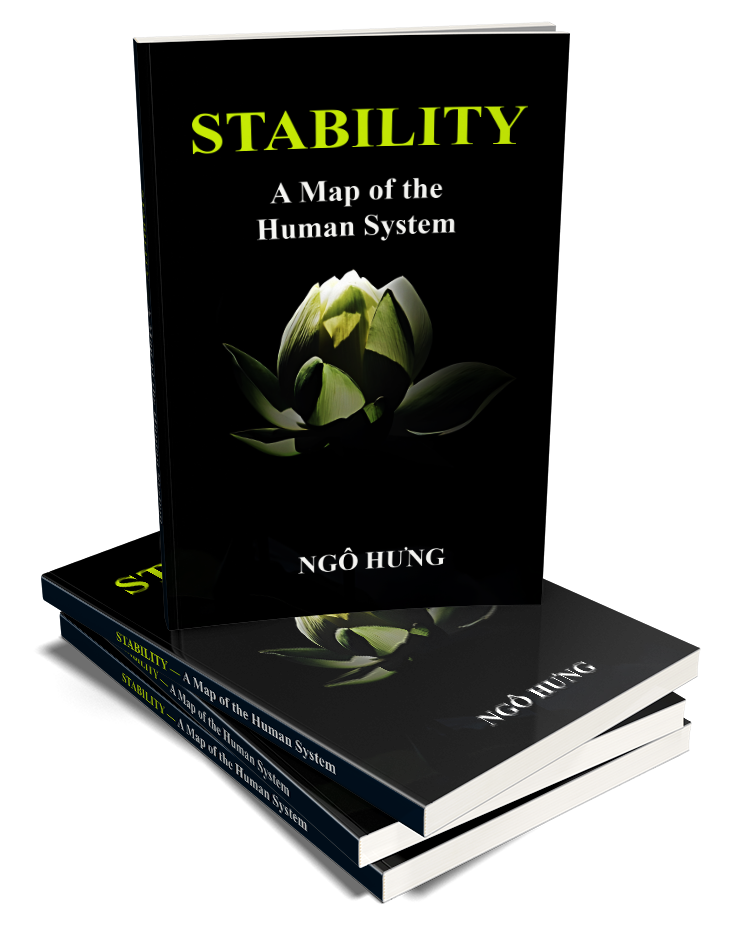
COMPREHENSIVE AND PROFESSIONAL REVIEW
STABILITY – A MAP OF THE HUMAN SYSTEM
A Multi-Perspective Evaluation
CORE THESIS & CENTRAL IDEA
⭐⭐⭐⭐⭐ (5/5)
Central Thesis
Human suffering does not arise from life itself,
but from misusing the way the human system actually functions.
Evaluation
- The thesis is exceptionally strong because it:
- does not blame the ego
- does not rely on karma
- does not promise liberation
- does not offer healing as a goal
- Stability is not presented as a state to be achieved, but as a natural outcome when the system stops interfering with itself incorrectly.
👉 This is a radically different definition of stability compared to most contemporary works.
INTELLECTUAL INDEPENDENCE
⭐⭐⭐⭐⭐ (5/5)
Evaluation
- The book does not depend on:
- traditional Buddhism
- clinical psychology
- non-duality teachings
- modern self-help frameworks
- It does not borrow authority from established systems to legitimize itself.
👉 STABILITY stands on its own internal coherence, not on borrowed credibility.
BUDDHIST STUDIES – YOGĀCĀRA – CONTEMPLATIVE TRADITIONS
⭐⭐⭐⭐☆ (4/5)
Strengths
- Demonstrates deep understanding of:
- The Four Noble Truths
- Yogācāra (Consciousness-Only)
- Insight practices (impermanence, non-self, observation)
Distinctive Choice
- No discussion of karma
- No promise of liberation
- No prescribed spiritual path
➡️ For traditional practitioners, this may feel “incomplete.”
➡️ For long-term practitioners, this restraint is precisely its value.
PSYCHOLOGY & THERAPY
⭐⭐⭐☆☆ (3/5)
Evaluation
- Accurately identifies:
- natural emotional arising and passing
- mechanisms that prolong suffering
- harmful over-intervention by consciousness
- However:
- no techniques
- no exercises
- no therapeutic interventions
👉 This is not a therapy book, and it should not be used as one.
Three stars reflect correct positioning, not a weakness.
ACADEMIC CHARACTER (NON-INSTITUTIONAL)
⭐⭐⭐⭐☆ (4/5)
Evaluation
- Closely aligned with:
- phenomenology
- systems thinking
- experiential inquiry
- Avoids metaphysical speculation
- Avoids ontological debates
Intentional Limits
- No empirical citations
- No institutional academic framing
👉 This is applied intellectual clarity, not university-bound scholarship.
STRUCTURE & SYSTEM INTEGRITY
⭐⭐⭐⭐⭐ (5/5)
Evaluation
- Clear functional layering of the human system
- Each chapter addresses one specific functional error
- No conceptual overlap or inflation
👉 The book shows strong cognitive discipline in its construction.
LANGUAGE & STYLE
⭐⭐⭐⭐⭐ (5/5)
Evaluation
- Language is:
- slow
- neutral
- non-seductive
- emotionally non-manipulative
- No reassurance
- No intimidation
- No artificial inspiration
👉 The writing style is perfectly aligned with the map it presents.
READER EXPERIENCE
⭐⭐⭐⭐☆ (4/5)
Best suited for
- Readers who have:
- studied spirituality
- practiced meditation
- explored psychology
- Yet still feel:
- subtle friction
- lingering imbalance
- quiet fatigue from “self-improvement”
Not suited for
- Acute psychological crisis
- Readers seeking quick relief
- Readers wanting step-by-step guidance
MASS APPEAL
⭐⭐☆☆☆ (2/5)
Evaluation
- Not designed for fast reading
- No viral quotes
- No dramatic emotional arc
👉 This lack of mass appeal is a deliberate choice, not a flaw.
LONGEVITY & TIMELESSNESS
⭐⭐⭐⭐⭐ (5/5)
Evaluation
- Not tied to healing trends
- Not dependent on contemporary science
- Not language-fashion driven
👉 This is a book that remains relevant decades later.
OVERALL CONCLUSION
STABILITY – A Map of the Human System
does not teach people how to become stable,
but shows where they are unknowingly destabilizing themselves.
It is:
- a foundational work
- and the conceptual ground for all subsequent volumes.
COMPARISON WITH PHILOSOPHERS AND J. KRISHNAMURTI
Philosophical Position of STABILITY
STABILITY is:
- not philosophy in the classical sense
- not anti-philosophical
It occupies a space that is:
- pre-theoretical
- post-doctrinal
- closely related to applied phenomenology, without naming itself as such.
👉 The comparison here is not about truth, but about levels of engagement with human experience.
COMPARISON WITH WESTERN PHILOSOPHERS
- Descartes
Fundamental divergence
|
Descartes |
STABILITY |
|
“I think, therefore I am” |
Does not ground existence in thought |
|
Consciousness as foundation |
Consciousness as a function |
|
Dualism |
Non-dual without declaration |
👉 STABILITY does not seek certainty for the self.
- Kant
Shared concern, different direction
|
Kant |
STABILITY |
|
Limits of knowledge |
Effects of misusing knowledge |
|
Structure of cognition |
Functional operation of living |
|
Conceptual system |
Non-conceptual mapping |
👉 Kant stops at epistemic boundaries.
👉 STABILITY examines the practical suffering caused by violating them.
- Husserl
Close proximity, clear divergence
|
Husserl |
STABILITY |
|
Return to direct experience |
Return to lived functioning |
|
Epoché |
Implied but unnamed |
|
Phenomenal analysis |
Functional distortion analysis |
👉 Husserl builds philosophy.
👉 STABILITY prevents misapplication.
- Heidegger
Depth intersection, different aim
|
Heidegger |
STABILITY |
|
Ontology of Being |
No ontology |
|
Existential anxiety |
Functional misalignment |
|
Dense language |
Minimalist language |
👉 Heidegger asks what it means to be.
👉 STABILITY asks how we interfere with living.
DIRECT COMPARISON WITH J. KRISHNAMURTI
- Strong Convergence
|
Krishnamurti |
STABILITY |
|
No path |
No path |
|
No authority |
No authority |
|
Seeing is sufficient |
Nothing needs to be added |
|
Rejection of spiritual systems |
No spiritual system created |
- Subtle but Crucial Differences
(a) Tone and Language
- Krishnamurti: confrontational, catalytic, awakening-oriented
- STABILITY: neutral, descriptive, non-provocative
👉 STABILITY does not attempt to awaken anyone.
(b) Position of the Speaker
- Krishnamurti speaks from a position of having seen
- Readers may feel: “I am not there yet”
- STABILITY avoids positional authority
- It only describes mechanisms
👉 This removes implicit spiritual hierarchy.
(c) Risk of Misuse
- Krishnamurti’s work risks:
- imitation of choiceless awareness
- striving to “see”
- turning insight into achievement
- STABILITY explicitly points out these exact distortions.
One could say:
STABILITY is the book Krishnamurti did not write,
but many readers after Krishnamurti deeply need.
- A Direct Contrast Statement
Krishnamurti says: “See.”
STABILITY asks: “What is happening when you try to see?”
FINAL COMPARATIVE CONCLUSION
If philosophy asks: What is a human being?
Krishnamurti asks: Why is the human mind not free?
STABILITY asks only this:
“Where are we interfering incorrectly with our own system?”
And because this question is small,
it reaches directly into lived life.