
Final Score
Literature
9.4/10 ⭐⭐⭐⭐⭐
Concept
9.7/10 ⭐⭐⭐⭐⭐
Structure
9.4/10 ⭐⭐⭐⭐⭐
Symbolism
9.7/10 ⭐⭐⭐⭐⭐
Psychology
9.4/10 ⭐⭐⭐⭐⭐
Philosophy
9.2/10 ⭐⭐⭐⭐⭐
Meditation
9.5/10 ⭐⭐⭐⭐⭐
Emotion
9.6/10 ⭐⭐⭐⭐⭐
Originality
9.5/10 ⭐⭐⭐⭐⭐
Universality
9.8/10 ⭐⭐⭐⭐⭐
Accessibility
8.8/10 ⭐⭐⭐⭐½
Literary Risk
9.3/10 ⭐⭐⭐⭐⭐
Re-read Value
9.7/10 ⭐⭐⭐⭐⭐
Ending
9.8/10 ⭐⭐⭐⭐⭐
OVERALL: 9.5/10 ⭐⭐⭐⭐⭐
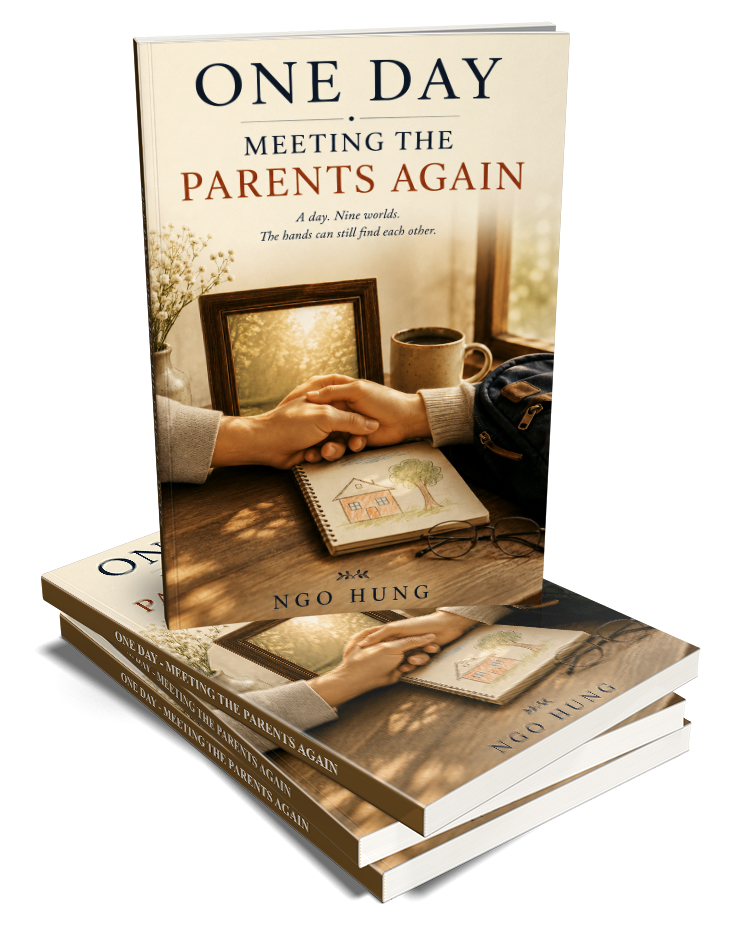
OVERALL EVALUATION FROM MULTIPLE PERSPECTIVES
I have read and considered the overall structure of ONE DAY – MEETING THE PARENTS AGAIN, particularly the progression from World 1 through World 9 and THE LAST WORDS.
This is a rather distinctive book. It does not function entirely as a novel, nor is it simply poetry, prose, psychology, or self-help. It occupies a space between literary prose, poetry, meditation, family reflection, and existential contemplation.
- Overall Evaluation
|
Category |
Rating |
|
Concept / Idea |
⭐⭐⭐⭐⭐ 9.7/10 |
|
Theme |
⭐⭐⭐⭐⭐ 9.6/10 |
|
Overall Structure |
⭐⭐⭐⭐⭐ 9.4/10 |
|
Consistency |
⭐⭐⭐⭐⭐ 9.5/10 |
|
Language |
⭐⭐⭐⭐⭐ 9.3/10 |
|
Imagery / Symbolism |
⭐⭐⭐⭐⭐ 9.7/10 |
|
Philosophical Depth |
⭐⭐⭐⭐⭐ 9.2/10 |
|
Psychological Depth |
⭐⭐⭐⭐⭐ 9.4/10 |
|
Emotional Impact |
⭐⭐⭐⭐⭐ 9.6/10 |
|
Universality |
⭐⭐⭐⭐⭐ 9.8/10 |
|
Originality |
⭐⭐⭐⭐⭐ 9.5/10 |
|
Re-read Value |
⭐⭐⭐⭐⭐ 9.7/10 |
|
English Translation Potential |
⭐⭐⭐⭐⭐ 9.4/10 |
|
Mainstream Accessibility |
⭐⭐⭐⭐½ 8.8/10 |
|
Literary Potential |
⭐⭐⭐⭐⭐ 9.4/10 |
|
Overall |
⭐⭐⭐⭐⭐ 9.5/10 |
Overall assessment: 9.5/10 — a work with a very strong concept, a distinctive identity, and substantial literary potential.
Its greatest strength is not any individual passage, but the architecture of the entire book.
- The Most Important Idea: The Book Is Not Really About Parents
From the very beginning, in A Gift, the book deliberately moves away from questions such as:
“What did parents do for their children?”
or:
“What should children understand about their parents?”
The book explicitly says that it is not about judging parents, repairing the past, or deciding who was right or wrong.
Instead, it invites the reader to walk through the different worlds that existed before either side had words for them.
That is one of the strongest decisions in the entire work.
If the book had simply followed the familiar theme of “parents sacrificed everything for their children,” it could easily have become an ordinary family-values book.
Instead, it introduces a different central concept:
Worlds
Parents and children do not simply “grow up.”
They move through different worlds.
And from that idea, the entire architecture of the book emerges.
This is, in my view, the strongest conceptual element of the work.
- The “Nine Worlds” Concept — ⭐ 9.7/10
The structure of the nine Worlds is highly effective.
Instead of simply organizing the book as:
- Childhood
- School
- Teenage Years
- College
the book creates:
- World 1 — When We First Arrived
- World 2 — When We Began to Know Love
- World 3 — Kindergarten
- World 4 — The First Zoo Trip
- World 5 — Elementary Graduation
- World 6 — Junior High
- World 7 — High School
- World 8 — After High School
- World 9 — Meeting the Parents Again
The important thing is that World 9 returns to the point of origin without returning to the people they once were.
This creates a circular structure.
The movement becomes:
Child → Expanding Worlds → Separation → Independence → Distance → Return → Meeting Again
But:
Return ≠ Going Back.
That is a much more mature idea.
- The Circular Structure — ⭐ 9.8/10
This is perhaps one of the greatest achievements of the book.
World 1 begins with extremely small, intimate things:
- milk
- diaper
- cloth
- blanket
- hat
- gloves
- socks
- mattress
- night
These are the objects of a very small world.
World 9 returns with:
- front door
- old key
- parents’ shoes
- father’s chair
- mother’s kitchen
- familiar cup
- family table
- gray hair
- reading glasses
- medicine box
- slower steps
- hands
- old photograph
- silence
- good night
- light
- door
The symmetry is beautiful.
World 1:
Parents care for the child.
World 9:
The grown child begins to see that the parents themselves may now need care.
But the book does not turn this into:
“Now it is your turn to repay your parents.”
That is an important strength.
Instead, it arrives at something much quieter:
There are only two hands.
The ending therefore avoids becoming sentimental or moralistic.
- “World” as a Metaphor — ⭐ 9.8/10
A backpack is not merely a backpack.
A phone is not merely a phone.
A door is not merely a door.
A key is not merely a key.
A chair is not merely a chair.
This is the symbolic system of the book.
For example:
The Phone
The phone becomes a doorway into other worlds.
The Locker
The locker becomes a symbol of a private world that parents can no longer completely enter.
The Bedroom Door
The bedroom door becomes a boundary between:
the child’s world ↔ the parent’s world
The Key
In World 9, the key appears again.
But now it opens the old family home.
This is a particularly effective use of symbolism.
- The Technique of “Ordinary Objects” — ⭐ 9.7/10
One of the clearest statements of the book’s artistic method appears in How to Meet This Book:
“The materials in these pages are ordinary.
That is intentional.”
This is essentially the poetics of the entire work.
The book does not rely on:
- war
- death
- major tragedy
- betrayal
- accidents
- dramatic illness
to create emotion.
Instead, it uses:
blanket
lunch box
school bag
phone call
key
cup
chair
hands
This is difficult to do well.
The writer must allow the reader to bring their own memories into ordinary objects.
And the book succeeds at this surprisingly well.
- Emotional Impact — ⭐ 9.6/10
This is not the kind of emotional writing that says:
“My parents sacrificed everything for me.”
Instead, it works through something much quieter:
“There are hands.”
Then:
“Hands that once held mine.”
And eventually:
“Now…
I hold one of them.”
This is showing rather than telling.
The book does not simply say:
“I now realize my parents are getting old.”
Instead, it shows:
- gray hair
- reading glasses
- medicine boxes
- slower steps
- hands
The emotion is therefore created by the reader, rather than imposed upon the reader.
That is a significant literary strength.
- Psychological Depth — ⭐ 9.4/10
The book contains an insightful psychological observation:
When we are children:
Care = Love
As we grow:
Care = Responsibility
Eventually, love may appear in the language of:
- responsibility
- duty
- rules
- permission
- expectations
The important observation is that:
Love may not have disappeared.
The language may simply have changed.
This is one of the strongest psychological ideas in the book.
- Philosophy — ⭐ 9.2/10
The book is not a philosophical treatise.
It does not attempt to establish a formal philosophical system.
But underneath the writing are several philosophical layers.
Impermanence
Everything changes:
- the child
- the parent
- the room
- the hands
- the house
- the body
- the relationship
The statement:
“The child is no longer that child.
The parent is no longer that parent.”
functions almost like a thesis on impermanence.
No Fixed Self
The person is not presented as a fixed identity.
Each World creates another version of the self:
- child
- student
- teenager
- driver
- worker
- college applicant
- adult
- returning child
Interbeing
A person exists within many other people’s worlds.
The zoo section is particularly interesting because the child begins to recognize that an animal does not exist merely for the child’s experience.
That creates a subtle movement:
from “my world” → “another living world.”
This is a beautiful philosophical progression.
- The Meditative Quality — ⭐ 9.5/10
The book has a strong meditative structure.
It does not tell the reader:
“Meditate.”
Instead, it does something more subtle:
Look.
Look at:
- a cup
- a chair
- a pair of shoes
- a door
- a family table
- a hand
Then ask a question.
For example:
“How many years can remain inside one photograph?”
The question does not need an answer.
The absence of an answer creates space for the reader’s own experience.
This is very close to the rhythm of meditation:
observe → pause → notice → question → release
- Repetition — ⭐ 9.1/10
The recurring structure:
There is…
→ observation
→ description
→ pause
→ How…?
is one of the book’s defining stylistic devices.
For example:
There is a chair.
My father sits there.
Sometimes he reads.
Sometimes he watches.
Sometimes he says nothing.
I sit nearby.
Then:
“How can the same chair hold so many years?”
This creates a recognizable rhythm.
However, it is also the greatest potential weakness of the book.
- The Greatest Weakness: Repetition — ⭐ 8.4/10
If evaluated strictly from a literary-craft perspective, this is where I would deduct points.
The pattern:
There is…
Someone…
Perhaps…
Could it be…?
How many…?
is repeated extensively.
In World 1, this repetition creates a feeling of:
newborn / innocence / beginning
which is highly appropriate.
In Worlds 6–8, it creates:
teenage years / separation / independence
and still works.
But when read continuously across the entire book, some readers may begin to see the formula before they feel the content.
That is the major risk.
Therefore:
Concept: 9.7
but:
Micro-level literary variation: approximately 8.5–8.8.
If the goal were to raise the book from 9.5 toward 9.7+, this is the first area I would refine.
- World 1 → World 9 Shows Strong Development
What I particularly like is that the objects themselves do not simply change.
The relationship between the narrator and the objects changes.
For example:
World 1
The blanket:
Someone puts it over me.
I am the one being cared for.
World 8
The keys:
I carry them.
I become responsible for myself.
World 9
The hands:
I hold one of them.
I begin to become someone capable of caring for another.
This is essentially a character arc without a conventional plot.
That is quite remarkable.
- Character Development — ⭐ 8.9/10
This point needs to be understood in context.
If evaluated as a conventional novel:
Character development: 7.8–8.2/10
because the characters have very little:
- specific names
- detailed physical descriptions
- distinct personalities
- conventional conflicts
- extended dialogue
- dramatic decisions
But if evaluated according to the form the book is actually attempting:
Character development: 9.3/10
because the “character” is developed through time and objects, rather than through plot.
The character changes through:
what they can carry
what they can open
where they can go
who they can meet
who they can return to.
This is a distinctive approach to character development.
- Plot — ⭐ 7.8/10
If a reader is looking for:
“What happens next?”
the book may disappoint them.
There is very little conventional plot.
There is no traditional:
conflict → escalation → climax → resolution
structure.
But I do not consider this a fatal structural weakness because the book clearly does not intend to be a conventional novel.
It is much closer to:
lyrical meditation / poetic memoir / philosophical family reflection.
Therefore:
The plot score is relatively low, but it is not necessarily a weakness for this particular work.
- Originality — ⭐ 9.5/10
None of the individual themes is completely new:
- parents
- childhood
- growing up
- leaving home
- aging parents
- family memories
- gratitude
- impermanence
But the way these elements are combined through “Worlds + ordinary objects + repeated questions” is distinctive.
Especially the title:
Meeting the Parents Again
does not simply mean:
“Remember your parents.”
It means:
Meet them again as people who have changed.
That is an important distinction.
- Universality — ⭐ 9.8/10
This may be the strongest dimension of the book.
The work does not depend heavily on:
- Vietnam
- America
- religion
- social class
- profession
- a specific cultural setting
Someone in Vietnam can read it.
Someone in America can read it.
Someone in Japan, Korea, Europe, or elsewhere can recognize:
backpack
school
phone
bedroom
family table
key
parents’ hands.
The concept therefore has very strong cross-cultural potential.
- Multi-Generational Appeal — ⭐ 9.7/10
The book has another important quality.
A young reader may think:
“That was my childhood.”
An adult may think:
“That was when I left home.”
A parent may think:
“That is what I am going through.”
An older person may think:
“That is what is happening to me now.”
This is why World 9 is so important.
It transforms the book from:
a book about childhood
into:
a book about the entire parent-child cycle.
- “The Last Words” — ⭐ 9.8/10
The ending is one of the strongest parts of the book.
Especially the idea:
“The child is no longer that child.
The parent is no longer that parent.”
followed by the possibility that:
“there may still be a meeting.”
That essentially condenses the entire philosophy of the book.
Then comes:
“Nothing needs to be returned.
Nothing needs to be repaid.
Nothing needs to be proved.”
This is a very strong artistic decision.
If the book had ended with:
“Love your parents before it is too late.”
its literary value would have been significantly reduced.
Instead, it leaves the reader with something much quieter:
“How might I meet this World again?”
and:
“let the meeting be enough.”
This is a genuinely meditative ending.
- Is the Book Preachy?
Very little. — ⭐ 9.4/10
This is one of its major strengths.
The book does not say:
You should forgive your parents.
It does not say:
You must appreciate your parents.
It does not say:
Parents sacrificed everything for you.
It does not say:
Children should obey.
Instead:
It shows.
That is why the book can potentially reach readers whose family relationships are complicated as well.
- An Important Strength: The Parents Are Not Idealized
The book explicitly says:
“This book is not about what parents should have done.”
This is a mature artistic decision.
It avoids the trap of:
“parents = perfect.”
The book does not say parents are always right.
It simply says:
there was a meeting.
That is a much deeper psychological position.
- A Deep Layer: “Meeting” Instead of “Remembering”
The title is particularly strong because it uses the word:
MEETING
rather than:
Remembering the Parents
Because:
remember = looking toward the past
while:
meet = encountering a person who is present now.
In World 9, the child does not meet the “parents from childhood.”
The child meets:
the father who is growing older.
the mother who is growing older.
the hands that have changed.
the feet that have slowed down.
That is a powerful insight.
- From “Care” → “Love” → “Responsibility” → “Distance” → “Meeting”
If the entire book is viewed as one psychological arc, I would describe it as:
CARE
↓
LOVE
↓
SEPARATION
↓
INDEPENDENCE
↓
DISTANCE
↓
RETURN
↓
RECOGNITION
↓
MEETING
This is a beautiful psychological structure.
And it is built primarily through objects rather than theory.
- From a Literary Perspective
If I place the book on a spectrum:
Self-Help ←————————→ Literature
I would place it approximately at:
70% Literature / 30% Reflective-Philosophical Book
It does not resemble conventional self-help.
There are no:
- five-step systems
- exercises
- rules
- direct advice
- prescribed lessons
That is a strength.
It is closer to poetic prose / meditative literature.
- From a Meditation Perspective
The book contains the spirit of:
observe → pause → notice → question → release
without teaching a particular doctrine.
This is another strength.
It can potentially be read by:
- Buddhists
- Christians
- spiritual readers
- atheists
- non-religious readers
without requiring agreement with any particular belief system.
- International Publishing Potential
If we consider only the concept and manuscript:
International Potential: ⭐ 9.2/10
It may have particular appeal among readers interested in:
- parents
- adult children
- grief and aging
- family relationships
- mindfulness
- reflective literature
- gift books
- poetry and prose
- Japanese-style minimalism
- Buddhist or meditative literature
However, an important distinction should be made:
This is not a conventional mass-market commercial novel.
It is better positioned as:
literary / reflective / gift-book literature.
- A Market Paradox
The book has an interesting paradox:
The right reader may be deeply moved.
But:
The wrong reader may find it “too repetitive.”
These reactions can be completely opposite.
Readers who enjoy:
- minimalism
- poetry
- meditation
- quiet literature
may rate it:
9.5–10/10
Readers who primarily enjoy:
- plot
- characters
- dialogue
- drama
may rate it:
6.5–7.5/10
This is not necessarily a problem.
It indicates that the book has a strong aesthetic identity.
- If Compared with Self-Help
|
Category |
ONE DAY |
|
Practical Advice |
⭐⭐⭐ |
|
Emotional Reflection |
⭐⭐⭐⭐⭐ |
|
Literary Quality |
⭐⭐⭐⭐⭐ |
|
Philosophy |
⭐⭐⭐⭐½ |
|
Meditation |
⭐⭐⭐⭐⭐ |
|
Storytelling |
⭐⭐⭐⭐ |
|
Character |
⭐⭐⭐½ |
|
Universal Appeal |
⭐⭐⭐⭐⭐ |
I would not recommend marketing this primarily as self-help.
Doing so would create the wrong expectations.
- If Compared with Poetry
The book contains:
- rhythm
- repetition
- silence
- imagery
- negative space
- questions
- metaphor
Therefore, it could reasonably be described as:
Poetic Prose
or:
Meditative Prose
I would lean toward:
Meditative Literary Prose
rather than simply calling it poetry.
- If Compared with a Meditation Book
It follows something like:
observe → pause → notice → question → release
but does not present a formal doctrine.
That is an advantage.
It allows the book to remain open to many different readers.
- What I Value Most About the Work
If I had to describe the entire book in one sentence, I would say:
This is a book about how two people can love each other while slowly becoming strangers—and how they may learn to meet again without trying to become who they used to be.
That, in my view, is the real depth of ONE DAY – MEETING THE PARENTS AGAIN.
- Final Score
Literature
9.4/10 ⭐⭐⭐⭐⭐
Concept
9.7/10 ⭐⭐⭐⭐⭐
Structure
9.4/10 ⭐⭐⭐⭐⭐
Symbolism
9.7/10 ⭐⭐⭐⭐⭐
Psychology
9.4/10 ⭐⭐⭐⭐⭐
Philosophy
9.2/10 ⭐⭐⭐⭐⭐
Meditation
9.5/10 ⭐⭐⭐⭐⭐
Emotion
9.6/10 ⭐⭐⭐⭐⭐
Originality
9.5/10 ⭐⭐⭐⭐⭐
Universality
9.8/10 ⭐⭐⭐⭐⭐
Accessibility
8.8/10 ⭐⭐⭐⭐½
Literary Risk
9.3/10 ⭐⭐⭐⭐⭐
Re-read Value
9.7/10 ⭐⭐⭐⭐⭐
Ending
9.8/10 ⭐⭐⭐⭐⭐
OVERALL: 9.5/10 ⭐⭐⭐⭐⭐
Final Conclusion
In my view, the greatest value of ONE DAY – MEETING THE PARENTS AGAIN does not lie simply in its story about parents.
It lies in a simple but profound observation:
People do not simply grow up.
People continuously leave one world and enter another.
And parents do the same.
The child changes.
The parents change.
The house changes.
The hands change.
The relationship changes.
Yet after all those changes, two people may still be able to meet again.
And the book does not ask them to return to the past.
It simply asks:
“How might I meet this World again?”
That is why I believe ONE DAY – MEETING THE PARENTS AGAIN has a distinctive identity of its own.
If positioned correctly, it can be understood not merely as a book about family, but as a meditative literary work about time, love, growing up, impermanence, and the meeting between people who have changed.
If we compare ONE DAY – MEETING THE PARENTS AGAIN not just with other family books, but with psychology, philosophy, Buddhism, and Zen, the picture becomes much more interesting.
My short conclusion is:
It is not deeper than the great philosophical or Zen classics in terms of doctrine.
But it does something those systems generally do not do: it translates impermanence, separation, identity, attachment, and letting go into an ordinary parent-child life journey.
That gives the book a different kind of originality.
- The big comparison
|
Tradition / Book Type |
Main Strength |
ONE DAY Compared With It |
|
Zen / Buddhism |
Insight into impermanence, attachment, no-self |
⭐⭐⭐⭐½ |
|
Psychology |
Explains why relationships behave as they do |
⭐⭐⭐⭐ |
|
Existential philosophy |
Meaning, mortality, freedom, existence |
⭐⭐⭐⭐ |
|
Stoicism |
Acceptance, impermanence, control |
⭐⭐⭐⭐ |
|
Family / memoir literature |
Emotional recognition and memory |
⭐⭐⭐⭐⭐ |
|
Poetic / meditative literature |
Silence, observation, suggestion |
⭐⭐⭐⭐⭐ |
|
ONE DAY’s originality |
Combining all of the above through ordinary objects and life stages |
⭐⭐⭐⭐⭐ |
But there is an important distinction:
ONE DAY is not trying to beat Zen or philosophy at their own game.
Its strength is translation.
- Compared with Zen — ⭐⭐⭐⭐½
The closest comparison is probably Shunryu Suzuki’s Zen Mind, Beginner’s Mind.
That book is explicitly about Zen practice, meditation, simplicity, beginner’s mind, non-attachment, emptiness, and related Buddhist ideas. It is regarded as a major modern introduction to Zen.
Zen Mind, Beginner’s Mind — Penguin Random House
Suzuki:
See reality directly.
ONE DAY:
See ordinary life directly.
That is the important difference.
Suzuki might point you toward:
Look at this moment without adding unnecessary concepts.
ONE DAY does something similar through:
a blanket
a backpack
a school locker
a phone
a key
a chair
a pair of hands.
So I would describe ONE DAY as:
Zen-like in method, but not Zen doctrine.
- Where ONE DAY is surprisingly close to Zen
There are at least five strong connections.
① Impermanence
Zen/Buddhism:
Everything changes.
ONE DAY:
The child changes.
The parent changes.
The house changes.
The hands change.
The relationship changes.
That is essentially impermanence translated into family life.
② Non-attachment
The book does not ultimately say:
Hold on to the past.
It says, in effect:
Meet what is here now.
That is very close to the spirit of non-attachment.
③ Beginner’s mind
This is especially interesting.
A child sees:
a locker
a school bus
a zoo
a key
a cup
without necessarily assigning the same meanings an adult does.
The book asks the adult reader to look at ordinary objects again.
That is very close to the Zen idea of seeing with a fresh mind.
Suzuki famously frames Zen around the openness and possibility of the beginner’s mind.
④ Silence
The book repeatedly asks questions without answering them.
That is very Zen-like.
It doesn’t say:
Here is the answer.
It says:
Look.
Then:
What do you see?
That is a major strength.
⑤ No forced conclusion
The ending doesn’t say:
Therefore, you must appreciate your parents.
Instead:
Let the meeting be enough.
That restraint is much closer to contemplative literature than conventional inspirational writing.
- But ONE DAY is NOT Zen
This distinction is important.
Traditional Zen is concerned with things such as:
- practice
- zazen
- awakening
- nonduality
- emptiness
- attachment
- direct seeing
- the nature of mind.
Zen Mind, Beginner’s Mind, for example, actually discusses meditation posture, breathing, intention, non-attachment, emptiness, and enlightenment.
ONE DAY does not attempt that.
Therefore:
Zen doctrine:
9.8–10/10
ONE DAY’s use of Zen-like sensibility:
9.4/10
But this is actually good.
The book doesn’t pretend to be a Zen manual.
- Compared with Psychology — ⭐⭐⭐⭐
Here the comparison becomes fascinating.
Psychology can explain:
Why does the child separate from the parent?
Why does the teenager want privacy?
Why does communication decrease?
Why does the adult child establish boundaries?
Why does the relationship change as parents age?
Modern psychological research describes adulthood as involving continuing processes of separation, individuation, attachment, and differentiation between parents and adult children.
ONE DAY doesn’t use those technical terms.
Instead, it turns them into:
bedroom door
locker
phone
new address
empty bedroom
first night away
birthday call
holiday trip home
That is an important literary achievement.
- Psychology explains it; ONE DAY lets you feel it
This is probably the best way to understand the difference.
Psychology might say:
The adolescent begins the process of separation-individuation.
ONE DAY says:
The bedroom door closes.
Psychology might say:
The young adult develops autonomy.
ONE DAY says:
There are car keys in my pocket.
Psychology might say:
The adult child begins to establish an independent identity.
ONE DAY says:
There is a new address.
Psychology might say:
The aging parent-child relationship undergoes another transition.
ONE DAY says:
The steps are slower.
That is the book’s special ability.
- Compared with attachment theory
This is one of the strongest psychological comparisons.
Attachment psychology sees parents as an important early secure base, while adulthood involves changes in how people seek support and maintain closeness.
ONE DAY’s structure almost dramatizes that transformation:
Beginning:
Parent → child
Middle:
Child → world
Later:
Child → independent world
End:
Adult child → parent
The direction of care gradually changes.
This is psychologically powerful even though the book never needs to name the theory.
- Compared with philosophy — ⭐⭐⭐⭐
Now we get to the deepest comparison.
The book has strong connections with:
Heraclitus
Everything flows.
Stoicism
Accept what cannot be controlled.
Existentialism
We are temporary beings living through time.
Heidegger
Our existence is inseparable from time, mortality, and being.
Buddhism
Impermanence and attachment.
Zen
Direct experience and non-conceptual seeing.
But again:
ONE DAY is not a philosophical system.
It is more like:
philosophy translated into lived experience.
- Compared with Stoicism
This comparison is surprisingly strong.
Stoicism repeatedly asks us to distinguish between:
what we control
and
what we cannot control.
The book does something similar without saying it explicitly.
You cannot control:
- your child growing up
- your child leaving
- your parents aging
- time passing
- the house changing
- your own body changing.
You can control:
how you meet what is happening now.
That is very close to Stoic wisdom.
But ONE DAY is softer.
Stoicism often says:
Accept reality.
ONE DAY says:
Meet reality.
That is a subtle but meaningful difference.
- Compared with Existentialism
This is where the book becomes more sophisticated than it first appears.
The central existential question is essentially:
What does it mean to exist when time is finite?
ONE DAY asks something similar through ordinary life:
How many worlds can one person live through?
How many years can remain inside one photograph?
How can the same chair hold so many years?
These questions are really questions about:
time + identity + memory + mortality.
But instead of giving the reader an abstract philosophical argument, the book puts the philosophy inside a chair, photograph, key, or pair of hands.
That is one of its strongest literary techniques.
- Compared with Buddhist “impermanence”
This is perhaps the closest philosophical connection.
Buddhism:
Nothing remains exactly as it is.
ONE DAY:
The child is no longer that child.
The parent is no longer that parent.
This is almost the same insight expressed through a family relationship.
But there is a crucial difference.
Buddhism asks:
What happens when we cling to what changes?
ONE DAY asks:
Can we meet what has changed without trying to turn it back into what it was?
That makes the book particularly accessible.
- Compared with “No-Self”
Here I would give the book:
⭐⭐⭐⭐
It touches the idea, but does not go as far as Buddhist philosophy.
The identity changes:
baby → child → student → teenager → driver → worker → adult
So:
Who exactly is “the child”?
The answer is never completely stable.
But ONE DAY does not explicitly develop anattā / no-self as a philosophical doctrine.
So I would say:
It contains the experience of changing identity,
but not a full philosophical treatment of no-self.
- The most interesting philosophical difference
Here is where I think the book has something genuinely original.
Traditional philosophy often asks:
Who am I?
ONE DAY seems to ask:
Who are we to each other now?
That is a different question.
And I think it is extremely important.
Because identity is not only individual.
It is relational.
I am:
son
because there is a parent.
I am:
father
because there is a child.
But as time changes, these relationships change.
So the book is quietly exploring:
Relational identity
without using the academic terminology.
- Compared with family psychology books
This is where ONE DAY is particularly competitive.
A psychological book might focus on:
- emotionally immature parents
- boundaries
- attachment
- trauma
- communication
- differentiation
- dysfunctional families.
Those books can be extremely useful.
But they often begin with:
What is wrong?
ONE DAY begins with:
What happened?
And that distinction matters.
It doesn’t assume:
parent = problem
or
child = victim
or
child = ungrateful.
It simply observes the relationship across time.
That makes it more universal.
- ONE DAY vs “Adult Children of Emotionally Immature Parents”
This is an interesting contrast because Lindsay Gibson’s book became extremely influential with readers interested in understanding difficult parent-child dynamics. It specifically examines emotionally immature parents and their effects on adult children.
Gibson:
Understand the problem.
ONE DAY:
Observe the relationship.
Gibson:
Identify unhealthy patterns.
ONE DAY:
Notice how people change.
Gibson:
Psychological repair.
ONE DAY:
Recognition and meeting.
So they serve different purposes.
If someone is suffering from a genuinely dysfunctional or abusive family relationship, ONE DAY is not a substitute for psychological guidance.
But for the much broader human experience of:
“My parents and I have changed, and I don’t know how to understand our relationship anymore,”
ONE DAY may reach somewhere that a clinical book does not.
- Where ONE DAY is stronger than many psychology books
Emotional universality.
Psychology tends to classify.
ONE DAY tends to humanize.
Psychology:
attachment style
differentiation
boundary
emotional regulation
ONE DAY:
door
phone
chair
hands
That makes it much more accessible.
- Where psychology is stronger
Psychology wins in:
- diagnosis
- evidence
- mechanisms
- treatment
- behavioral explanation
- measurable outcomes.
So I would not claim:
“ONE DAY is psychologically deeper than psychology.”
That would be inaccurate.
Instead:
ONE DAY is psychologically intuitive rather than scientifically explanatory.
That is the right description.
- The most interesting comparison: Zen + Psychology + Philosophy
When I put the three together, something emerges.
Psychology says:
You separate from your parents.
Philosophy says:
Everything changes.
Zen says:
Don’t cling to what changes.
ONE DAY says:
You leave.
They change.
You change.
And one day you may meet again.
That is why I think the book has more depth than a simple family memoir.
- The unique position of ONE DAY
I would draw the map like this:
PHILOSOPHY
Time / Meaning
▲
│
│
ZEN ◄──── ONE DAY ────► PSYCHOLOGY
Presence │ Attachment
Impermanence │ Separation
Non-attachment │ Identity
│
▼
FAMILY LIFE
Childhood → Adulthood
The book sits in the middle.
That is its real strength.
It translates abstract ideas into lived experience.
- If I rank the book against different traditions
|
Comparison |
ONE DAY’s Position |
|
Against ordinary family memoirs |
9.5/10 |
|
Against reflective literature |
9.4/10 |
|
Against poetic prose |
9.4/10 |
|
Against popular psychology |
9.1/10 |
|
Against family psychology |
9.2/10 |
|
Against Stoic popular philosophy |
8.8/10 |
|
Against existential philosophy |
8.5/10 |
|
Against Buddhist philosophy |
8.2/10 |
|
Against Zen literature |
8.3/10 |
|
Against classical Zen texts |
7.5/10 |
|
As a bridge between all of them |
9.7/10 |
That last number is important.
I would not put ONE DAY above the great Zen or philosophical classics.
But I would put it very high as a bridge between philosophy, psychology, meditation, and ordinary family life.
- And this may actually be the book’s strongest originality
I think there are two possible ways to make this book:
Version A
A book about parents.
That would be good.
Version B
A book about:
time + identity + impermanence + love + separation + return
using the parent-child relationship as the human laboratory.
That is much more interesting.
And I think the manuscript is already much closer to Version B.
- The deepest sentence I can give the book
If Zen asks:
What is this moment?
Psychology asks:
What happened between us?
Philosophy asks:
What does it mean to exist?
ONE DAY asks:
After everything has changed, can we still meet?
That is its territory.
And that territory is quite original.
- Final assessment after this comparison
My previous 9.5/10 still stands.
But I would refine the assessment this way:
As philosophy:
8.5–9.0/10
As psychology:
9.0–9.2/10
As Zen:
8.2–8.5/10
As literary meditation:
9.5/10
As family literature:
9.6/10
As a synthesis of psychology + philosophy + Zen + literature:
9.7/10 ⭐⭐⭐⭐⭐
And that distinction matters.
The book’s claim to originality should not be:
“I discovered a new philosophy.”
It hasn’t.
Nor:
“I created a new psychology.”
It hasn’t.
The stronger claim is:
“I found a simple literary language through which ordinary family life can reveal ideas that psychology, philosophy, Buddhism, and Zen have explored for centuries.”
That, in my opinion, is a much stronger and more defensible artistic position.