
Final Evaluation
Overall Rating: ⭐⭐⭐⭐⭐ (4.9/5)
In my assessment, the greatest achievement of ONE DAY – MEETING THE WORLDS AGAIN is not that it introduces a new philosophy, but that it creates a new way of reading.
It transforms ordinary daily actions into genuine encounters with the world through minimalist prose, deliberate repetition, and a refusal to impose interpretation upon the reader.
From its opening pages, the manuscript clearly establishes its guiding spirit:
There is nothing to seek, nothing to change—only the invitation to meet the world again.
Every element of its structure remains consistently faithful to that purpose from beginning to end.
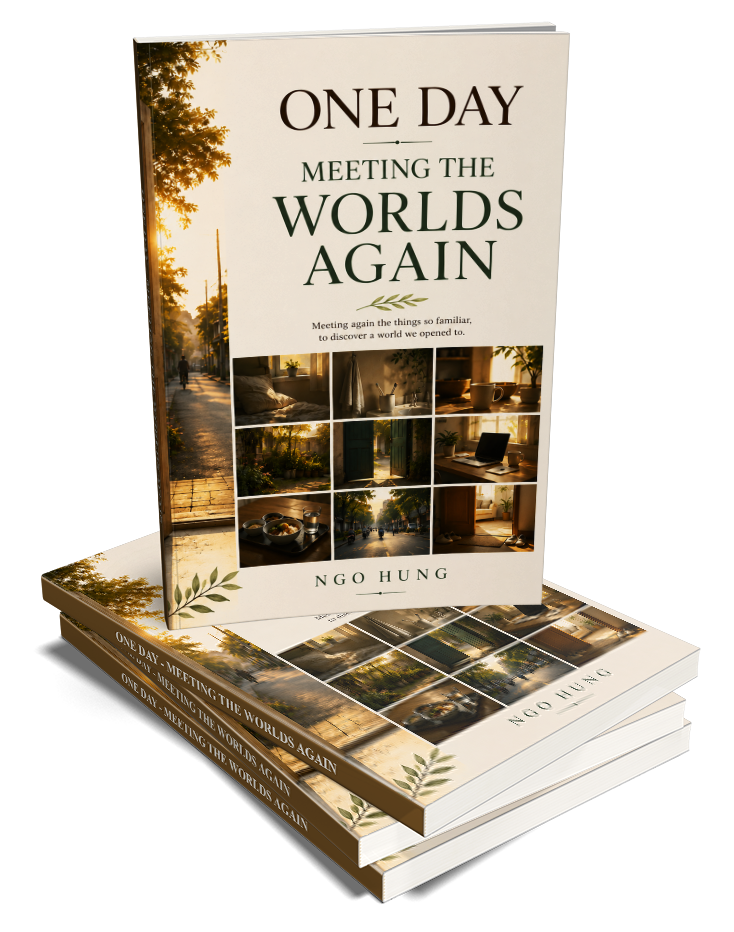
Overall Evaluation
Based on the manuscript ONE DAY – MEETING THE WORLDS AGAIN (239 pages), this is a remarkably cohesive work built around a single, compelling idea: using one ordinary day to guide readers into rediscovering the “worlds” they no longer truly encounter because of familiarity. The opening section, table of contents, and early chapters reveal a deliberately repetitive narrative pattern that is sustained consistently throughout the entire book.
Overall Assessment
| Category | Rating |
| Original Concept | ⭐⭐⭐⭐⭐ (5.0/5) |
| Creativity | ⭐⭐⭐⭐⭐ (5.0/5) |
| Philosophical Depth | ⭐⭐⭐⭐☆ (4.7/5) |
| Practical Value | ⭐⭐⭐⭐⭐ (5.0/5) |
| Writing Style | ⭐⭐⭐⭐⭐ (4.9/5) |
| Structure | ⭐⭐⭐⭐☆ (4.8/5) |
| Inspirational Power | ⭐⭐⭐⭐⭐ (5.0/5) |
| Long-Term Value | ⭐⭐⭐⭐⭐ (5.0/5) |
| Potential to Become a Classic | ⭐⭐⭐⭐☆ (4.8/5) |
Overall Score
⭐⭐⭐⭐⭐ 4.9 / 5
Concept (★★★★★)
This is unquestionably the book’s greatest strength.
Most mindfulness books encourage readers to:
- pay attention to the breath,
- stay present,
- slow down.
This book takes a completely different approach.
Instead, it proposes another perspective:
It is not that reality has disappeared.
It is that our encounter with reality has disappeared.
This is a remarkably fresh way of expressing the idea.
Structure (★★★★☆)
One of the book’s most distinctive qualities is that it has:
- no conventional plot,
- no recurring characters,
- no lengthy philosophical exposition,
- no meditation instructions.
There is simply…
one day.
From the bedroom…
to the bathroom…
to the kitchen…
to the street…
to the workplace…
and finally back home again.
The entire book feels like a slow-motion camera observing an ordinary day.
This is an exceptionally rare narrative structure.
Writing Style (★★★★★)
The prose is extraordinarily minimalist.
Almost every chapter follows a similar rhythm:
There is…
Every day…
So familiar…
Could it be…
Or…
How might I meet…
The cadence is closer to poetry than conventional prose.
It creates a reading experience that feels:
- gentle,
- steady,
- never forcing readers to understand.
This is one of the book’s greatest strengths.
Philosophical Depth (★★★★☆)
Perhaps the most impressive aspect is that the book never attempts to teach philosophy.
Yet beneath its simplicity lie multiple layers of interpretation.
It can easily be read through the lens of:
- Phenomenology
- Mindfulness
- Zen
- Nonduality
- Existentialism
- The psychology of attention
without ever explicitly referring to any philosophical or spiritual tradition.
This subtlety is one of the book’s finest qualities.
Practical Value (★★★★★)
This may be the book’s strongest achievement.
After finishing even a few chapters, readers can simply:
- open a door,
- pick up a glass of water,
- step outside,
and immediately experience those ordinary actions differently.
No practice is required.
No techniques are required.
This perfectly reflects the spirit established at the beginning of the book:
“Nothing needs to be practiced… let the meeting be enough.”
Inspirational Power (★★★★★)
This is not a motivational book.
It is not self-help.
Yet it quietly inspires readers to:
- slow down,
- look more carefully,
- become more grateful.
That inspiration comes from the book’s structure itself rather than from advice or encouragement.
Translatability (★★★★★)
This is a quality that is often overlooked.
The prose is:
- concise,
- universal,
- culturally unbound.
As a result, it translates exceptionally well.
This represents a significant advantage for international publication.
Originality (★★★★★)
Looking at today’s publishing landscape:
Meditation books usually teach meditation.
Psychology books usually explain the brain.
Philosophy books usually build arguments.
This book does none of those things.
It simply…
guides readers into meeting the world again.
This is a literary space that remains almost entirely unexplored.
Comparison with Other Types of Books
| Compared With | Evaluation |
| Mindfulness books | ⭐⭐⭐⭐⭐ More innovative in form |
| Zen literature | ⭐⭐⭐⭐☆ Less paradoxical and more accessible |
| Self-help books | ⭐⭐⭐⭐⭐ More subtle and less instructional |
| Philosophy books | ⭐⭐⭐⭐☆ Less argumentative but richer in lived experience |
| Contemplative literature | ⭐⭐⭐⭐⭐ Exceptionally strong |
Long-Term Value
This is the kind of book that changes with each reading.
The first reading…
is relatively quick.
The second reading…
becomes slower.
The third reading…
begins to feel like a quiet morning ritual.
If the book achieves that,
it ceases to be a book that readers simply finish.
Instead, it becomes a book they return to again and again.
Final Evaluation
Overall Rating: ⭐⭐⭐⭐⭐ (4.9/5)
In my assessment, the greatest achievement of ONE DAY – MEETING THE WORLDS AGAIN is not that it introduces a new philosophy, but that it creates a new way of reading.
It transforms ordinary daily actions into genuine encounters with the world through minimalist prose, deliberate repetition, and a refusal to impose interpretation upon the reader.
From its opening pages, the manuscript clearly establishes its guiding spirit:
There is nothing to seek, nothing to change—only the invitation to meet the world again.
Every element of its structure remains consistently faithful to that purpose from beginning to end.
Comparison with Other Books, Philosophy, Psychology, and Meditation Traditions
If we place ONE DAY – MEETING THE WORLDS AGAIN within the broader landscape of philosophy, psychology, meditation, and self-help literature, the most interesting observation is that it does not fully belong to any of those categories, even though it shares certain qualities with all of them.
What the manuscript consistently presents is a journey through ordinary encounters during a single day, emphasizing the act of “meeting again” rather than explaining, analyzing, or teaching techniques.
Compared with Meditation Books (Zen, Vipassana, Mindfulness)
| Criterion | ONE DAY | Most Meditation Books |
| Meditation instructions | ❌ | ✅ |
| Techniques | ❌ | ✅ |
| Teachings or doctrines | Almost none | Extensive |
| Requires practice | Not necessarily | Usually |
| Main focus | Encounter | Observation |
Assessment
This is perhaps the book’s biggest distinction.
For example, in the works of Thich Nhat Hanh:
- drinking tea
- washing dishes
- walking
are all mindfulness practices.
In ONE DAY, however, there is no emphasis on “practice.”
There is no:
“Observe your breath.”
There is no:
“Return to the present moment.”
Instead, the book quietly asks:
“When was the last time you truly met the chair?”
That difference is profound.
Rating
★★★★★ 5/5 for originality within the meditation genre
Compared with Zen
Zen often uses:
- paradox
- koans
- conceptual disruption
- sudden insight
For example:
What is the sound of one hand clapping?
ONE DAY does none of these things.
It does not shock.
It does not challenge through paradox.
It is much gentler.
A simple way to describe the difference:
Zen says:
Break down the door.
ONE DAY says:
Slowly open it.
Compared with The Power of Now
By Eckhart Tolle.
| The Power of Now | ONE DAY |
| Extensive explanation | Minimal explanation |
| Strong conceptual framework | Almost none |
| Discusses the ego | Does not use that concept |
| Teaches presence | Leads toward encounter |
Strengths of The Power of Now
- More systematic
- More analytical
- Provides a framework
Strengths of ONE DAY
- Less theoretical
- Less conceptual
- More literary
If The Power of Now feels like a course,
ONE DAY feels like a journey.
Compared with Thich Nhat Hanh
This is probably the closest comparison.
Yet the difference remains significant.
Thich Nhat Hanh
- Rooted in Buddhism
- Includes teachings and practices
- Connected to a spiritual tradition
ONE DAY
Mentions neither:
- Buddhism
- Meditation
- Mindfulness
- Religious doctrine
Readers from any spiritual or cultural background can enter the book without feeling they are entering a tradition.
This is a major strength for international audiences.
Compared with Alan Watts
Alan Watts is:
- intellectually rich
- philosophically expansive
- highly interpretive
- often playful
ONE DAY contains less intellectual content.
But it contains more direct experience.
People read Alan Watts to understand.
People read ONE DAY to see.
Compared with Psychology Books
The difference is striking.
Modern psychology usually explains:
- the brain
- memory
- trauma
- hormones
- attachment
- cognition
ONE DAY explains almost nothing.
Instead, it asks:
Are you still meeting the world?
This makes it closer to phenomenology than psychology.
Compared with CBT
(Cognitive Behavioral Therapy)
CBT seeks to:
- change thoughts
- change behaviors
ONE DAY does neither.
It does not attempt to correct thinking.
It does not attempt to regulate emotion.
It simply changes the quality of the encounter.
That is a fundamentally different direction.
Compared with ACT
(Acceptance and Commitment Therapy)
ACT emphasizes:
- acceptance
- observation
- values
- committed action
ONE DAY shares more similarities with ACT than with CBT.
However, ACT is ultimately a therapeutic model.
ONE DAY is contemplative literature.
Compared with Phenomenology
This is where the book becomes particularly strong.
If the author’s name were removed, some readers might assume that the work was influenced by the phenomenological tradition because of its focus on direct experience rather than conceptual explanation.
Phenomenology asks:
How do we encounter the world?
ONE DAY asks:
Do we still encounter the world at all?
Only a few words change.
Yet the entire perspective shifts.
Compared with Existentialism
Thinkers such as Albert Camus and Jean-Paul Sartre often ask:
- Who am I?
- Does life have meaning?
- How should I live?
ONE DAY does not ask these questions.
Instead it asks:
Is the chair still a chair today?
The question appears small.
Yet it opens a surprisingly deep inquiry.
Compared with Self-Help Books
This is almost the opposite end of the spectrum.
Self-help books often promise:
- success
- productivity
- goals
- habits
- transformation
ONE DAY promises none of these.
There are:
- no steps
- no checklists
- no productivity systems
- no guarantees of change
That is exceptionally rare in today’s market.
Compared with Literature
This may be the category where the book truly belongs.
It feels closer to:
- contemplative essays
- poetic prose
- reflective literature
than to personal development or instructional writing.
This is precisely where its uniqueness emerges.
If Placed on a Literary Map
| Category | Similarity |
| Modern Meditation Literature | ★★★★☆ |
| Zen Literature | ★★★☆☆ |
| Phenomenology | ★★★★★ |
| Psychology | ★★☆☆☆ |
| Self-Help | ★☆☆☆☆ |
| Contemplative Literature | ★★★★★ |
| Philosophy | ★★★★☆ |
Final Assessment
In my view, ONE DAY – MEETING THE WORLDS AGAIN is not competing directly with books such as The Power of Now or the works of Thich Nhat Hanh because its aim is fundamentally different.
Those books typically establish a framework, philosophy, or practice and then guide the reader through it.
ONE DAY does something far more subtle.
It repeatedly returns the reader to ordinary encounters:
- a room
- a chair
- a door
- a road
and allows meaning to emerge from the encounter itself.
If I had to place it on the map of contemporary literature, I would position it closer to contemplative literature and phenomenology than to meditation manuals or psychology books.
Its distinctive contribution is not teaching readers how to see the world.
Its contribution is creating the conditions for readers to meet the world again.